
Skin lesions - diagnosis and removal in Wrocław
Skin lesions such as skin tags, warts, keratoses or xanthelasma can be a cosmetic or a health issue. That is why we start with a dermatologist’s assessment - with dermatoscopy if needed - and only then choose how to remove them. At Luna Clinic in Wrocław diagnosis is carried out by Katarzyna Cygan, MD, PhD.
Skin lesions such as skin tags, warts, keratoses or xanthelasma can be a cosmetic or a health issue. That is why we start with a dermatologist’s assessment - with dermatoscopy if needed - and only then choose how to remove them. At Luna Clinic in Wrocław diagnosis is carried out by Katarzyna Cygan, MD, PhD.
Indications
Moles that change their shape, size, colour or begin to itch or bleed are an indication for a dermatoscopic examination. Undiagnosed, they can potentially turn into a skin cancer such as melanoma. Early diagnosis allows the quick removal of suspicious lesions and the avoidance of complications.
Benign lesions such as fibromas or viral warts can cause mechanical discomfort (abrasions), infections or aesthetic problems. An indication for their removal is their rapid growth, pain or frequent irritation. Treatments such as cryotherapy, electrocoagulation or surgical removal are effective and safe.
Broken capillaries or vascular lesions visible on the face, legs or other parts of the body can be an indication for treatment. If the lesions are visible, cause discomfort or bleed, it is worth undertaking laser therapy or sclerotherapy. Treatment helps improve the skin’s aesthetics and prevents further problems.
Lesions that are asymmetrical, have irregular edges, varied colour or grow quickly require urgent dermatological diagnostics. These may be precancerous conditions (actinic keratosis) or cancers (basal cell carcinoma, melanoma). An indication for intervention is the rapid development of the lesion or the appearance of pain, itching or ulceration.
Types of skin lesions
Skin lesions can take various forms such as macules, papules, blisters, pustules or nodules. They can result from inflammatory conditions, infections, allergies or other dermatological disorders. Some of them, like moles or warts, are benign, while others, e.g. pigmented lesions of irregular shape, may require quick diagnostics to rule out skin cancers.
Diagnostyka zmian
The assessment of skin lesions begins with a detailed dermatological examination, including dermatoscopy, which allows a precise analysis of the lesion’s structure. If necessary, the doctor may order additional tests such as a skin biopsy, allergy tests or laboratory tests. Early diagnostics is crucial, especially for lesions that may be a symptom of more serious systemic diseases.
Leczenie
The treatment of skin lesions depends on their nature and cause. In the case of infections, topical or oral antibacterial, antifungal or antiviral medications are used. Allergic skin lesions require antihistamine therapy and avoidance of allergens, while inflammatory lesions such as eczema or psoriasis are often treated with steroid preparations or calcineurin inhibitors. The therapy is supported by appropriate skin care, which relieves irritation and aids regeneration. Regular visits to the dermatologist help monitor and adjust treatment to the patient’s individual needs.
Frequently asked questions
Which skin lesions can be removed at Luna Clinic?
We remove pigmented moles, fibromas, seborrhoeic and viral warts, sebaceous cysts, lipomas and other benign skin nodules. Lesions suspected of being cancerous we remove surgically with histopathological examination.
Does every lesion need to be examined before removal?
Yes - we assess every lesion dermatoscopically, and excised moles are routinely sent for histopathological examination. This matters for oncological safety.
What methods do you use to remove skin lesions?
Depending on the nature of the lesion: surgically, with a laser, by electrocoagulation or cryodestruction (freezing). The method is proposed by the doctor after assessing the lesion - not every one may be removed with a laser.
Does the removal of skin lesions hurt?
We perform the treatments under local anaesthesia, so the treatment itself is painless. After the anaesthesia wears off, slight tenderness of the area may appear for 1-2 days.
Is there a scar after removal of the lesion?
After surgical removal a small, linear scar remains, which lightens over time. Ablative methods (laser, cryo) usually leave only a slight lightening of the skin.
Can a removed lesion grow back?
Lesions excised surgically in their entirety do not grow back. After superficial methods (e.g. freezing warts), recurrences requiring repetition of the treatment are possible.
Which moles should cause concern?
Asymmetrical ones, with uneven edges and non-uniform colour, larger than 6 mm and those that change, itch or bleed (the ABCDE rule). Such lesions require an urgent dermatoscopic assessment.
How to prepare for the removal of a skin lesion?
It is enough to come with healthy, non-tanned skin; inform the doctor about blood-thinning medications and a tendency to keloids. For a surgical procedure, plan to spare the area for a few days.
How to care for the skin after the procedure?
Keep the wound clean, use the recommended dressing or ointment, avoid soaking it for 24-48 hours and protect the area from the sun until it is fully healed.
When will I get the histopathology result?
The result is usually available within 2-3 weeks. We discuss it with the patient and - if necessary - plan further action.
Can skin lesions be removed in summer?
Yes, although after the procedure strict sun protection of the healing area is necessary. We remove suspicious lesions regardless of the season - safety is the priority.
How much does the removal of a skin lesion cost in Wrocław?
The price depends on the size and number of lesions, the method and the histopathological examination. You will receive a precise quote after a consultation; you will find indicative prices in the Luna Clinic price list.
Contraindications
A consultation has no significant contraindications. Any limitations concern selected treatment methods (e.g. laser vs. a tan, isotretinoin vs. pregnancy) - we will discuss them once a diagnosis is established.
How to prepare?
It is worth bringing to the visit:
- a list of medications and supplements taken
- existing documentation and test results
- a list of questions - nothing should slip your mind
- for skin lesions: do not cover them with make-up or irritate them before the visit
How does the procedure go?
We plan the treatment after a thorough skin assessment (with dermatoscopy if needed).
Recovery and recommendations
Diagnostic visits require no recovery. For treatments (e.g. laser) you will receive brief recommendations: sun protection, gentle care and avoiding high temperatures for a few days.
Effects - when and for how long?
Effect: depends on the condition and the therapy plan.
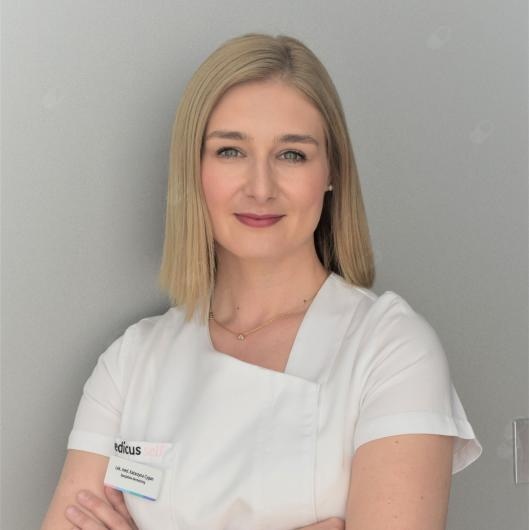
Katarzyna Cygan, MD, PhD
An experienced dermatologist and venereologist, a graduate of Wrocław Medical University. She diagnoses and treats skin diseases in patients of all ages - from dermatoscopic assessment of moles to laser therapy, microneedling radiofrequency and regenerative therapies with platelet-rich plasma. She combines dermatological and aesthetic knowledge, caring for skin that is healthy, young and natural.
Take the first step
Book a consultation - an honest conversation about expectations, possibilities and the treatment plan.
Skin lesions - diagnosis and removal: price and consultation
Treatment of skin lesions is quoted individually at Luna Clinic, as it depends on the number and size of the lesions, the method and histopathology. The starting point is a dermatology consultation (PLN 250). Pigmented moles that need excising are removed surgically - mole removal starts at PLN 600.
How to book
Call +48 666 850 666 (Monday-Friday, 9:00-17:00) or send the consultation form. All prices: Luna Clinic price list.
Where we are
Luna Clinic, ul. Władysława Syrokomli 46, 51-141 Wrocław, Poland - in the Karłowice area of the Psie Pole district. There is parking for patients by the clinic. Directions and map