
Dermatoscopy - mole check in Wrocław
Dermatoscopy is a non-invasive examination of moles and skin lumps under magnification and special light. It shows the structure of a lesion and identifies those that need monitoring or removal with histopathology. At Luna Clinic in Wrocław the examination is carried out by a dermatologist - Katarzyna Cygan, MD, PhD.
Dermatoscopy is a non-invasive examination of moles and skin lumps under magnification and special light. It shows the structure of a lesion and identifies those that need monitoring or removal with histopathology. At Luna Clinic in Wrocław the examination is carried out by a dermatologist - Katarzyna Cygan, MD, PhD.
Indications
Dermatoscopy is indicated for people who notice changes in the appearance of their moles, such as asymmetry, uneven edges, colour change, rapid growth or itching. A dermatoscopic examination allows a detailed analysis of these features, which is crucial in assessing the risk of melanoma or other skin cancers. Early diagnosis enables effective treatment and prevents serious consequences.
Dermatoscopy is recommended as a regular mole check, especially for people with a large number of pigmented lesions or in the melanoma risk group (e.g. genetic burden, fair complexion, frequent sun exposure). The examination makes it possible to detect even subtle changes in the structure of moles, which allows them to be monitored or removed if necessary.
Dermatoscopy is indicated when nodules appear on the skin whose nature is difficult to assess with the naked eye. The examination allows benign lesions such as fibromas or lipomas to be distinguished from potentially dangerous ones such as basal cell carcinoma or squamous cell carcinoma. This allows the dermatologist to decide on further treatment or removal of the lesion.
Dermatoscopy is also used in monitoring moles and skin lesions after their partial removal or treatment. This makes it possible to assess whether a recurrence of the lesion or the appearance of worrying features indicating malignancy has occurred. Regular examination ensures effective control of skin health and minimises the risk of overlooking potential threats.
When is it worth having a dermatoscopy?
Dermatoscopy is particularly recommended in the case of: the presence of new moles or nodules on the skin; changes in the appearance of existing moles, such as enlargement, change of colour or shape or the appearance of asymmetry; the occurrence of itching, burning or bleeding from a mole; genetic burden - if there have been cases of melanoma or other skin cancers in the family; exposure to intense UV radiation, which increases the risk of skin lesions.
Why is dermatoscopy important?
Early diagnosis of skin lesions is crucial for the effective treatment of skin cancers, especially melanoma, which can be fatal if detected too late. Dermatoscopy allows benign lesions to be precisely distinguished from potentially dangerous ones, which eliminates the need to remove healthy moles. This examination is an essential element of health prevention, especially in people with a large number of moles or those who regularly use a solarium.
How often should dermatoscopy be performed?
People with a fair complexion, with numerous moles, and those with a family history burdened by skin cancers should have a dermatoscopy at least once a year. In the case of suspicious lesions, the examination should be carried out more frequently, in accordance with the dermatologist’s recommendations. Regular mole checks are an important way to protect health and detect worrying changes early.
Frequently asked questions
What does a dermatoscopy examination involve?
Dermatoscopy is a non-invasive examination of moles at high magnification using a dermatoscope. It allows structures invisible to the naked eye to be assessed and early features of skin cancers, including melanoma, to be detected.
Does dermatoscopy hurt?
No - the examination is completely painless and non-invasive. The dermatoscope is applied only to the surface of the skin, and the examination can be repeated as often as desired, including in children and pregnant women.
How often should moles be examined?
Preventively once a year. People with numerous moles, a fair complexion, after sunburns or with melanoma in the family should check their skin every 6 months.
Which moles should cause concern?
Use the ABCDE rule: asymmetry, uneven edges, non-uniform colour, diameter over 6 mm and evolution, i.e. any change in appearance. Itching, bleeding and new lesions after the age of 40 should also cause concern.
Does dermatoscopy allow melanoma to be detected?
Yes - dermatoscopy significantly increases the detection of melanoma at an early, fully curable stage. We refer suspicious lesions for surgical removal with histopathological examination.
How to prepare for a mole examination?
Come without make-up or self-tanner, with skin free of creams. If you notice specific worrying changes, note down since when they have been changing - this is valuable information for the doctor.
How long does a dermatoscopy examination take?
A review of all the moles on the body usually takes 20-30 minutes. We discuss the result and recommendations immediately after the examination - there is no need to wait for results.
What happens if a mole turns out to be suspicious?
The doctor recommends its complete surgical removal together with a histopathological examination, which definitively determines the nature of the lesion. We perform the procedure under local anaesthesia.
Can skin nodules also be assessed dermatoscopically?
Yes - dermatoscopy helps differentiate fibromas, seborrhoeic warts, angiomas or basal cell carcinomas. On this basis the doctor decides on observation or removal of the lesion.
Is a dermatoscopic examination safe during pregnancy?
Yes, completely - it is an optical examination, without radiation or interference with the skin. Pregnancy favours changes in the appearance of moles, which is why a check-up during this period is actually recommended.
Do I need a referral for dermatoscopy?
No - we perform the examination as part of a private dermatological consultation at Luna Clinic, without a referral. You just need to book an appointment.
Dermatoscopy - mole check in Wrocław: how much does it cost?
Dermatoscopy costs PLN 300 in our price list.
Is it covered by the NFZ (Polish public health insurance)?
Luna Clinic sees patients privately and without a referral. Under the NFZ, mole assessment is done by a dermatology clinic, which requires a referral.
Contraindications
A consultation has no significant contraindications. Any limitations concern selected treatment methods (e.g. laser vs. a tan, isotretinoin vs. pregnancy) - we will discuss them once a diagnosis is established.
How to prepare?
It is worth bringing to the visit:
- a list of medications and supplements taken
- existing documentation and test results
- a list of questions - nothing should slip your mind
- for skin lesions: do not cover them with make-up or irritate them before the visit
How does the procedure go?
We plan the treatment after a thorough skin assessment (with dermatoscopy if needed).
Recovery and recommendations
Diagnostic visits require no recovery. For treatments (e.g. laser) you will receive brief recommendations: sun protection, gentle care and avoiding high temperatures for a few days.
Effects - when and for how long?
Effect: depends on the condition and the therapy plan.
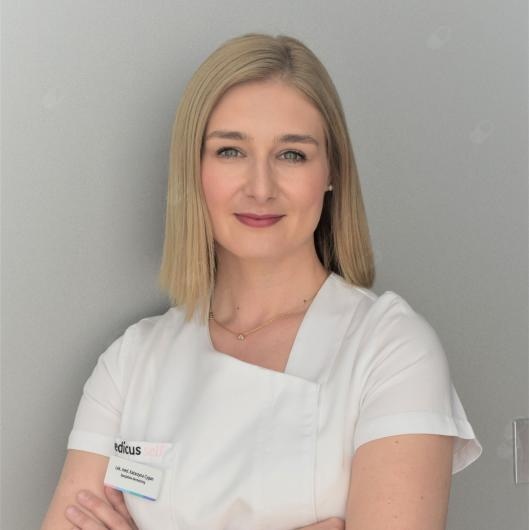
Katarzyna Cygan, MD, PhD
An experienced dermatologist and venereologist, a graduate of Wrocław Medical University. She diagnoses and treats skin diseases in patients of all ages - from dermatoscopic assessment of moles to laser therapy, microneedling radiofrequency and regenerative therapies with platelet-rich plasma. She combines dermatological and aesthetic knowledge, caring for skin that is healthy, young and natural.
Take the first step
Book a consultation - an honest conversation about expectations, possibilities and the treatment plan.
Dermatoscopy - mole check: price and consultation
Dermatoscopy (assessment of moles and skin lumps) costs PLN 300 at Luna Clinic. If a lesion needs removing, we perform surgical mole removal (from PLN 600) with histopathology.
How to book
Call +48 666 850 666 (Monday-Friday, 9:00-17:00) or send the consultation form. A dermatology consultation costs PLN 250. All prices: Luna Clinic price list.
Where we are
Luna Clinic, ul. Władysława Syrokomli 46, 51-141 Wrocław, Poland - in the Karłowice area of the Psie Pole district. There is parking for patients by the clinic. Directions and map